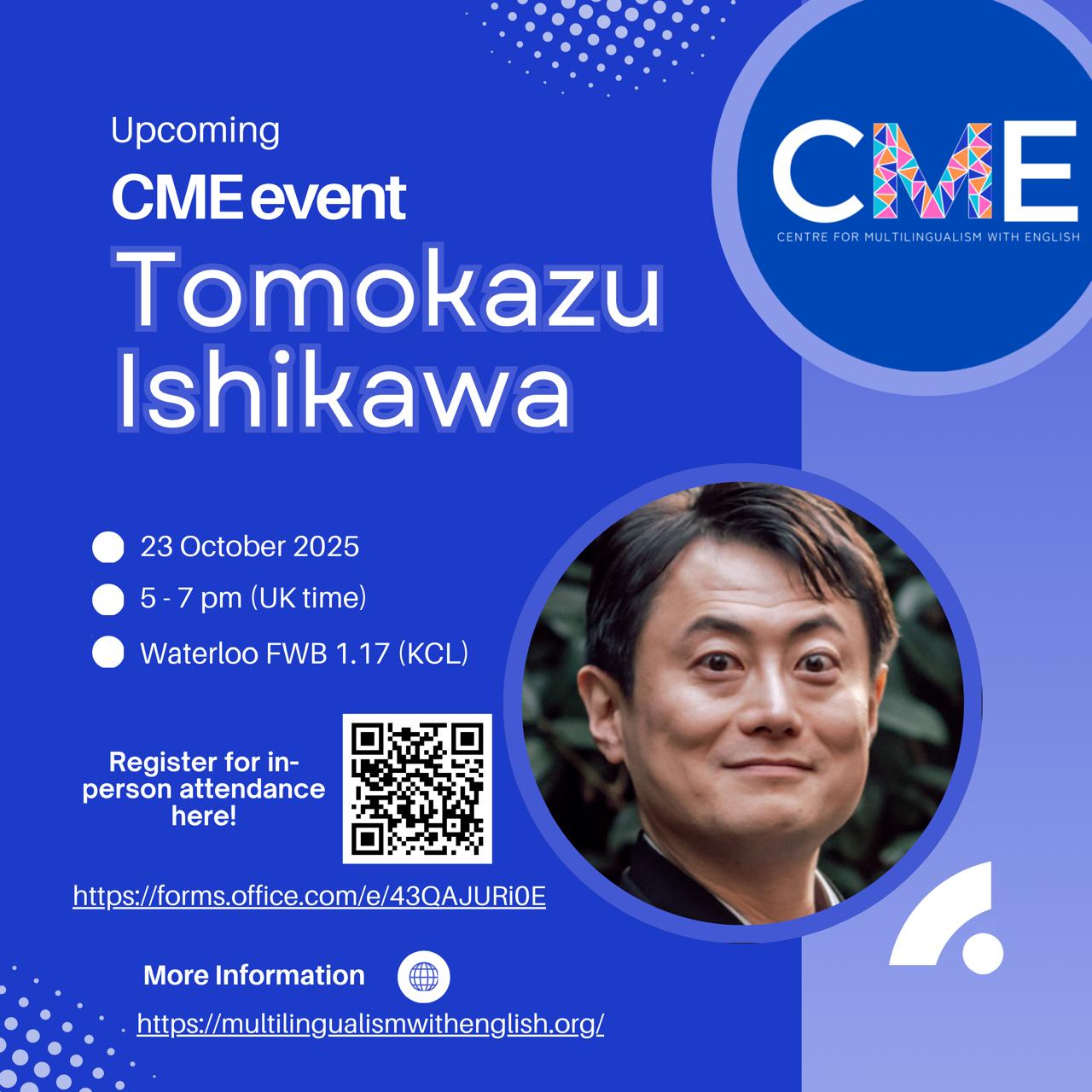
Intricate spatial scales and decolonial possibilities in transcultural communication
Global mobility offers increasing opportunities for more transient encounters. As a corollary, it is not always clear what specific named cultures participants draw upon in communication. Nor is it always possible to assume specific shared cultural practices among interactants. So far transcultural communication studies have addressed blurred boundaries across spatial scales ranging from the local to the global, as well as across the physical and the digital. Less explored is the possibility of transgressing and transcending the boundaries between the virtual and actual meanings through communicative resources, including English. Taking some East Asian pop songs as examples, this talk will explore the possibility of multilayered meaning construction through the intertwining of metaphorical and physical dimensions of ‘storytelling’. This expanded understanding of spatial scales will be linked to decoloniality in multilingualism with English.
Where is the “Classroom” in our Study of Englishes—And Why?
In this talk-conversation, Dr. Ruanni Tupas will examine the often-overlooked role of the classroom in the sociolinguistics of Englishes. Typically positioned as a mere recipient of sociolinguistic knowledge, the classroom—like the broader field of education—is rarely recognized in the field as a site of knowledge production in its own right. We usually frame our work as having ‘implications’ for the classroom; what about the implications of the classroom for our sociolinguistic work and theorising? He has mapped a particular configuration of this unequal relationship through his years of professional engagement with teacher development in Southeast Asia and explore ways to address it. More importantly, he will invite discussion on how we might rethink the role of classrooms as active contributors to the theorization and study of Englishes.
Translanguaging Among English, the National Language, and Ethnic Languages: Initial Findings from a Participatory Action Research
@KCL Waterloo Campus, Franklin Wilkins Building (FWB) Room 1.17 on 15th May, 5-7pm.
Dr. Tae Hee Choi will present the findings and key lessons from a British Council-funded project she co-leads, titled “Empowering English Language Teachers to Adopt Multilingual Pedagogy: The Case of Multilingual Nepal” (https://edpolicyresearch.wixsite.com/choitaehee/group/eltra-project-funded-by-the-british-council/about). Historically, Nepali was the sole medium of instruction in Nepal’s schools, but English gained prominence due to its perceived socioeconomic advantages (Choi & Poudel, 2024). Although a new multilingual policy now permits the use of ethnic languages as official instructional mediums, integrating them into the education system has been challenging.
To support this transition, the project team are developing pedagogical models through participatory action research, empowering teachers to implement multilingual practices. The study involved 12 teachers from four public schools across Kathmandu, Lalitpur, and Makawanpur districts. These teachers co-planned lessons, maintained reflective journals on their use of translanguaging in various subjects, and participated in regular feedback sessions with the research team.
The findings indicate that the co-constructed translanguaging approach fostered epistemic justice while promoting inclusivity and autonomy for both teachers and students. Despite these successes, several obstacles had to be addressed. This presentation will share the experiences of both teachers and researchers from this transformative initiative, offering insights into the practical application and research process. Additionally, it will explore the broader implications for promoting multilingualism in the face of public preference for dominant languages like Nepali and English.
Reference
Choi, T. H., & Poudel, P. P. (2024). Enactment of English medium instruction in under-resourced educational contexts: A case of multilingual public secondary schools in Nepal. System, 121, 103223.
Bio
Dr. Choi Tae Hee is an Associate Professor at Southampton Education School, University of Southampton, and a Fellow of both the UK’s Higher Education Academy and the US’s East-West Center. She served as President of the Comparative Education Society of Hong Kong (2016–2018) and is currently a Co-Convenor for the Policy Studies and Politics of Education network within the European Educational Research Association (2023–present).
Dr. Choi’s research centres on the intersection of language and educational change, including areas like policy reforms. She has published over 100 academic and professional works, including a book on the outsourcing of English language teaching published by Springer (https://link.springer.com/book/10.1007/978-981-97-8573-5). Dr. Choi has delivered more than 80 keynotes, talks, and seminars across Europe, Asia, and North America. She also advises international organizations, including the Asian Productivity Organization and the British Council, offering expertise in educational change management, staff development, and curricular innovation.
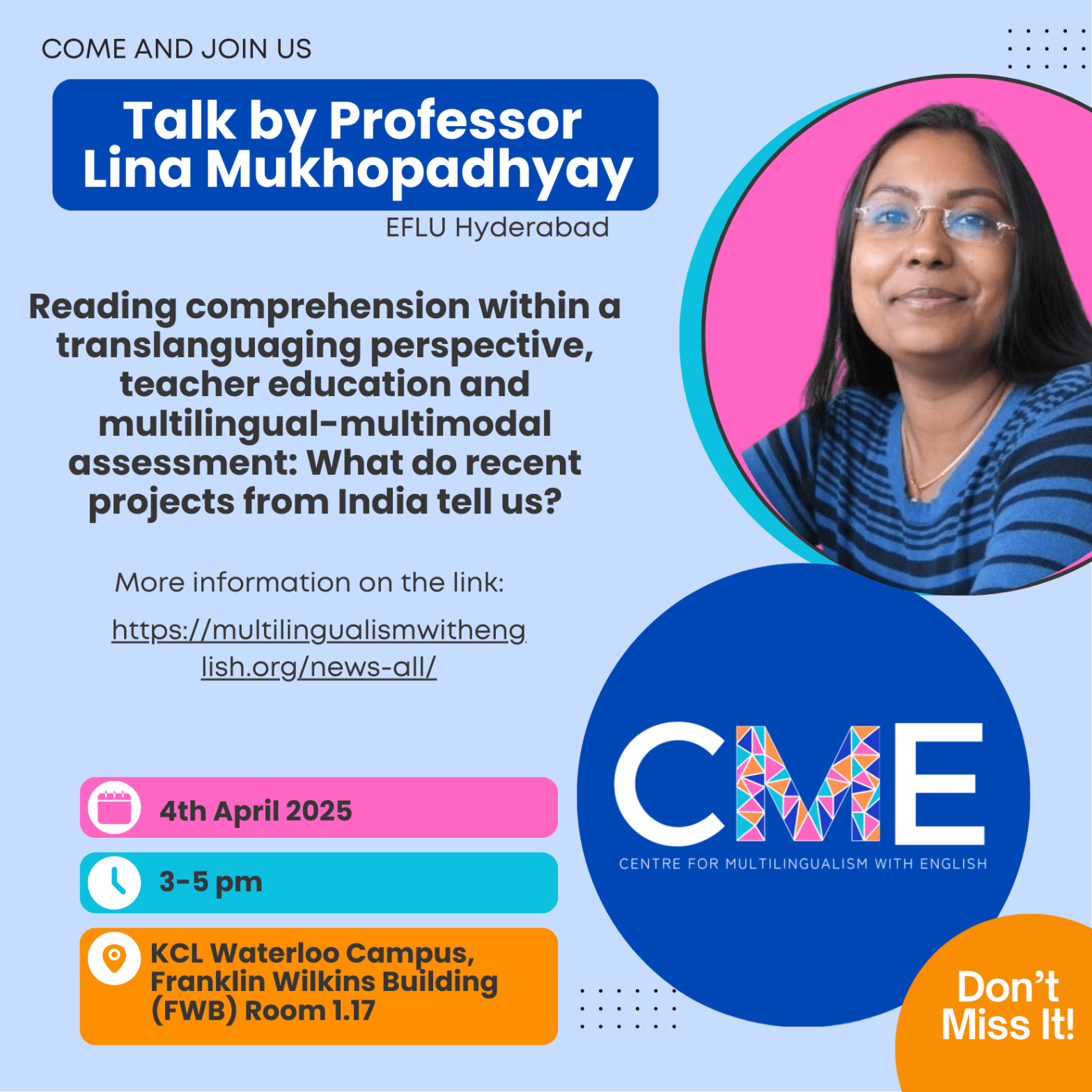
Reading comprehension within a translanguaging perspective, teacher education and multilingual-multimodal assessment:What do recent projects from India tell us?
@KCL Waterloo Campus, Franklin Wilkins Building (FWB) Room 1.17 on 4th April, 3-5pm.
A majority of multilingual (ML) children across the globe, especially from low SES families, do not enjoy the home language to language of instruction overlap especially when the latter is English, and in contexts where it is not a language spoken at home or has limited use outside the classroom. This creates a huge learning disadvantage for such children globally (UNESCO GEM report 2014, 2016). This trend was evident in a recently completed project in India (MultiLiLa 2016-2020) with 2500 plus fourth and fifth grade multilingual children’s learning through English and other language(s) of instruction (Hindi and Telugu). The project funded by British Academy was led by the University of Cambridge in collaboration with a consortium of higher academic institutions in India and UK and took place in north (Delhi), east (Bihar) and south (Telangana) of India. The print comprehension skills in English of the children were much lower than in Hindi and Telugu though their oral comprehension and production skills were much higher across languages suggesting that multilingual orality is strong in children from low SES families, which can be used as resource to leverage their learning of and in English (Tsimpli et al., 2020). The project also provided evidence of teachers using a mix of languages to teach English but their multilingual input was fragmented and not structured to scaffold learning English.
In an attempt to help teachers utilise the linguistic resources of children and scaffold their reading comprehension in English (and become multicompetent), a series of follow up projects led by the University of Cambridge in collaboration with the English and Foreign Languages University (EFLU), Hyderabad, the capital city of Telangana, from 2019 to 2023 were undertaken in Telangana. Thereafter, another project was taken up in Delhi and Assam funded by British Council India and led by the University of Cambridge in collaboration with EFLU and a consortium of Indian and a German university from 2023 to 2026. In all these projects, the focus was on using translanguaging pedagogy to train teachers to use learners’ multilingual resources to scaffold their English reading comprehension and vocabulary-in-context skills in language and content classrooms. The projects were able to assess multilingual children through multilingual-multimodal assessments, which have provided evidence that growth in children’ s comprehension can be tracked when they read in English and express understanding in a language they use at home. This presentation will report the results from the follow up projects for supporting early reading and integrative skill acquisition in low resource primary schools in India. The presentation will conclude by drawing implications for future work towards pre- and in-service teacher education in using multilingual pedagogy and create a model for inclusive language education for multilingual societies in the Global South.
Professor Lina Mukhopadhyay is the Head of Department of Training & Development, The English and Foreign Languages, EFLU Hyderabad, India
Integrating English as a Lingua Franca and Disciplinary Literacies in Higher Education: Insights from English as a Medium of Instruction
@KCL Waterloo Campus, Waterloo Bridge Wing (WBW) Room 3/7 on 5th December, 6-8pm. This is an in-person event at KCL (WBW), you will need to register to access the building. Please register here: https://forms.office.com/e/jLsxsSTZbp
Over the past two to three decades, English as a Medium of Instruction (EMI) and English as a Lingua Franca (ELF) have become key areas of research in global higher education contexts. Examining the interplay between EMI and ELF reveals that EMI serves as evidence of ELF’s presence in academic contexts. Therefore, it is essential to recognize that the role of EMI instructors extends beyond facilitating content knowledge; they are also responsible for effectively communicating subject matter in linguistically diverse classrooms. Understanding the link between ELF and Disciplinary Literacies (DL) in EMI settings highlights the critical role of language in generating and exchanging knowledge. This study, using a disciplinary literacies framework, investigates the strategies educators employ to cultivate discipline-specific language and literacy skills for multilingual students in inclusive learning environments. It highlights the necessity for students to acquire subject-specific language, regardless of their linguistic background, aligning with ELF principles. By focusing on language use in EMI classrooms, the study demonstrates its significance in shaping both disciplinary discourse and comprehension. The practical recommendations stemming from this research provide valuable insights for educators, administrators, and policymakers navigating the complex relationship between ELF and DL. Embracing linguistic diversity, fostering cross-cultural communication, and equipping stakeholders with effective pedagogical tools can enhance the inclusivity and success of EMI.
Keywords: English as a Medium of Instruction (EMI), English as a Lingua Franca (ELF), Disciplinary Literacies (DLs), language proficiency, linguistic diversity. Please register for this event here: https://forms.office.com/e/jLsxsSTZbp
Bio: Yasemin BAYYURT is professor of Applied Linguistics at Boğaziçi University, Istanbul, Türkiye, and one of the leading researchers in pedagogy of ELF and ELF-awareness within English Language Teaching (ELT). Her current research projects focus on English as medium of instruction (EMI) in higher education and ELF connection – one of them is supported by Boğaziçi University Research Fund and the other is supported by Turkish Scientific and Technological Association (TÜBITAK); and she is also part of the COST (European Cooperation in Science and Technology) Action Project entitled “CLIL Network for Languages in Education Towards bi- and multilingual disciplinary literacies: CLILNetLE (CA21114)”.
Prof. Yasemin Bayyurt has extensively researched WE-/ELF-awareness in ELT; ELF-aware teacher education, multilingualism and linguistic landscape. Her publications include articles in various indexed journals (e.g., Language Culture and Curriculum, Journal of Multilingual and Multicultural Development,…); edited books and book chapters published by national/international publishers. She currently edited “Bloomsbury World Englishes Volume 3: Pedagogies”, published by Bloomsbury, 2021; and co-edited “English as a Lingua Franca in the Language Classroom: Applying Theory to ELT Practice” published by Routledge, 2024.
Study Abroad as Teacher Training: Supporting Pre-service Teachers’ ELF Experiences
Teams Meeting on 13th November 2024 at 4-5pm. Link to join is below
Study abroad (SA) is widely recommended for English language teachers in many countries, especially in East Asian countries like Japan where English does not play a prominent role in everyday society. SA is believed to offer various benefits including the advancement of English language proficiency and the development of intercultural communicative competence. As a result, it has been incorporated into some teacher training programs in these regions. However, recent research suggests that simply undertaking SA does not automatically ensure these benefits. For example, English as a Lingua Franca (ELF) research in SA contexts has revealed that a limited understanding of ELF communication can hinder meaningful intercultural engagement, highlighting the need for educational support to maximize the benefits of SA. This talk focuses on Japanese pre-service English teachers who participated in SA as part of their teacher training programme. It examines how pre- and post-SA educational support related to ELF helped shape their understanding of these experiences, using mainly reflective interviews. The overall aim of the talk is to consider how educational support for ELF experiences can enhance the intercultural benefits of SA as teacher training.
The talk will be held online via MS Teams Meeting on 13th November 2024 at 4-5pm. You can join the meeting here or through the following credentials:
Meeting ID: 325 583 411 09
Passcode: 4uXEw7
Bio
Ayako Suzuki is a Professor in the Department of English Language Education at Tamagawa University, Japan. She teaches general English, EAP, and sociolinguistics to both undergraduate and graduate students. She has also been actively involved in the management of the university’s Center for English as a Lingua Franca. Her research interests include ELF, ELT, teacher education, and intercultural citizenship.
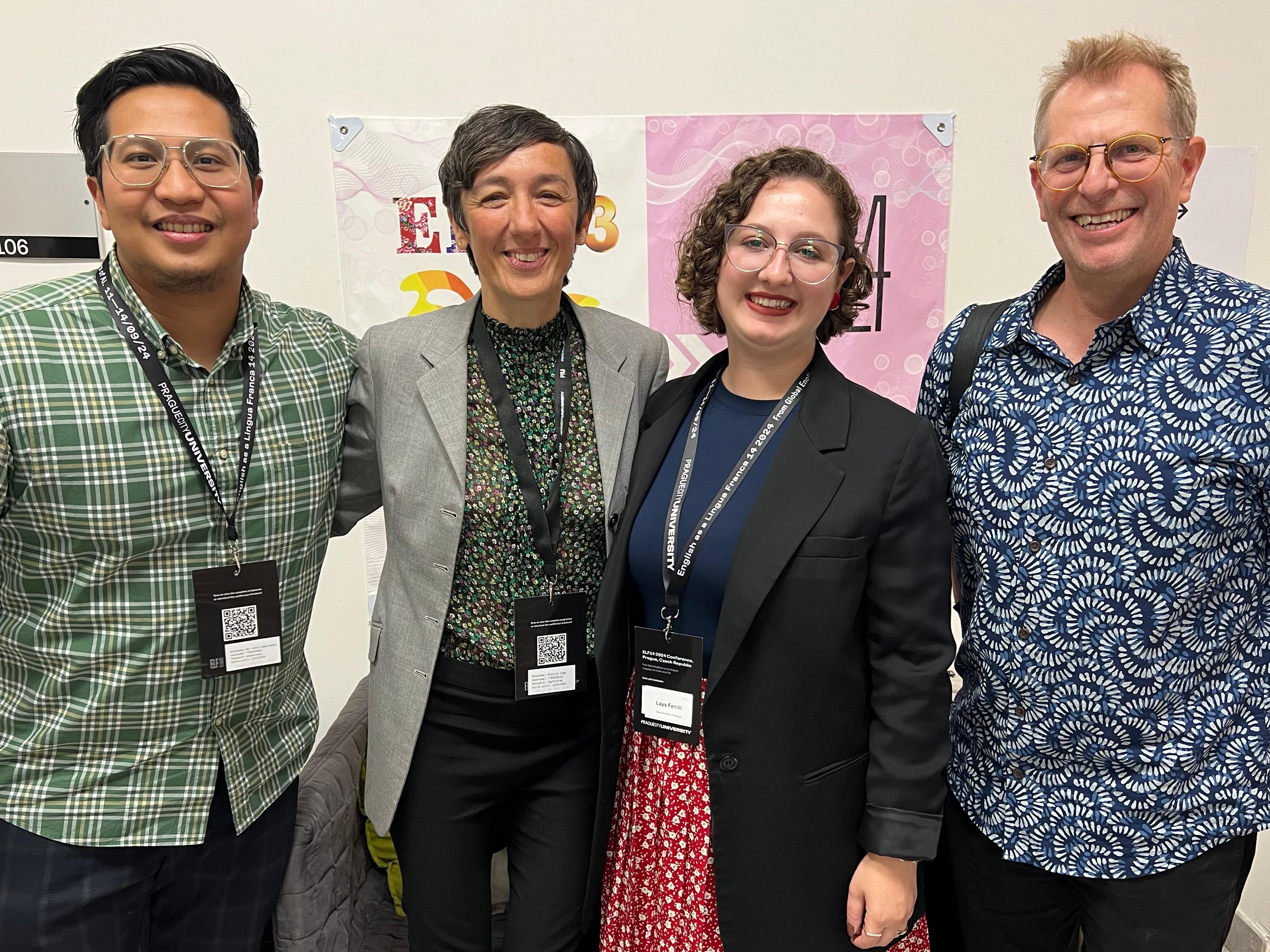
CME team in ELF14 (left to right): Hafiz, Alessia, Lays, and Martin
This year’s ELF14 conference was held in person (with an online participation option) in Prague, marking the first face-to-face event since ELF12 in Medellin, Colombia, five years ago. The previous ELF13 in 2022 was mainly a webinar hosted in Taiwan. ELF14 took place from September 11-14, 2024, across two main venues: Prague City University and Charles University, with a hybrid conference option.
Day 1 (September 11): The event kicked off with a drinks reception and registration at Prague City University in the afternoon, filled with excitement as ELF scholars reconnected. Many attendees expressed their joy at the return of on-site conferences.
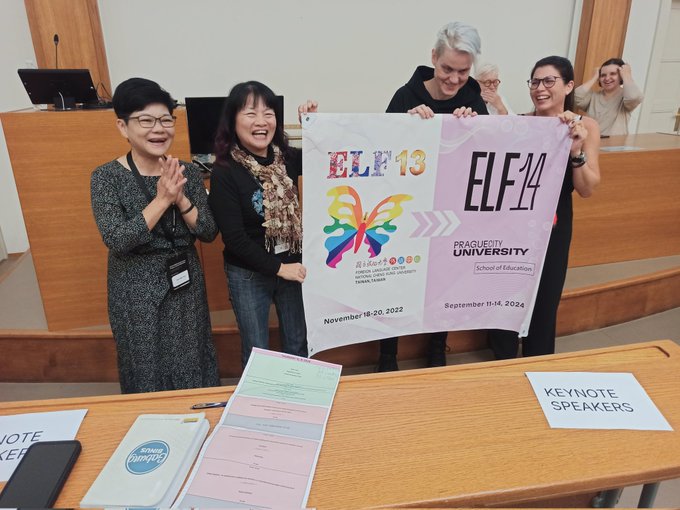
Symbolic handover from ELF13 to ELF14 hosts
Day 2 (September 12): The morning session at Charles University featured a symbolic handover from ELF13 host Professor Wenli Tsou to the current hosts: Dr. Veronica Quinn Novotna, Dr. Jirina Dunkova, Professor Peter Howe (Prague City University), and Professor Jakub Rakosnik (Charles University). The first plenary session, led by Professor Barbara Seidlhofer along with Dr. Martin Dewey and Dr. Marie-Luise Pitzl, focused on the evolution and future of ELF research. This was followed by a Fireside chat between AI experts Jakub Bares and Kerstin Cable, moderated by Dr. Jirina, discussing the relevance of AI in English language learning. After a coffee break, Professor Heath Rose delivered a plenary on the future directions for Global Englishes/ELF intervention research in curricula. Dr. Nicola Galloway concluded the morning session with her thoughts on Global Englishes.
The afternoon sessions at Prague City University featured parallel sessions where participants shared their research through individual presentations and colloquia, followed by Q&A sessions. The day ended with guided tours of Prague Castle and Prague City at night.
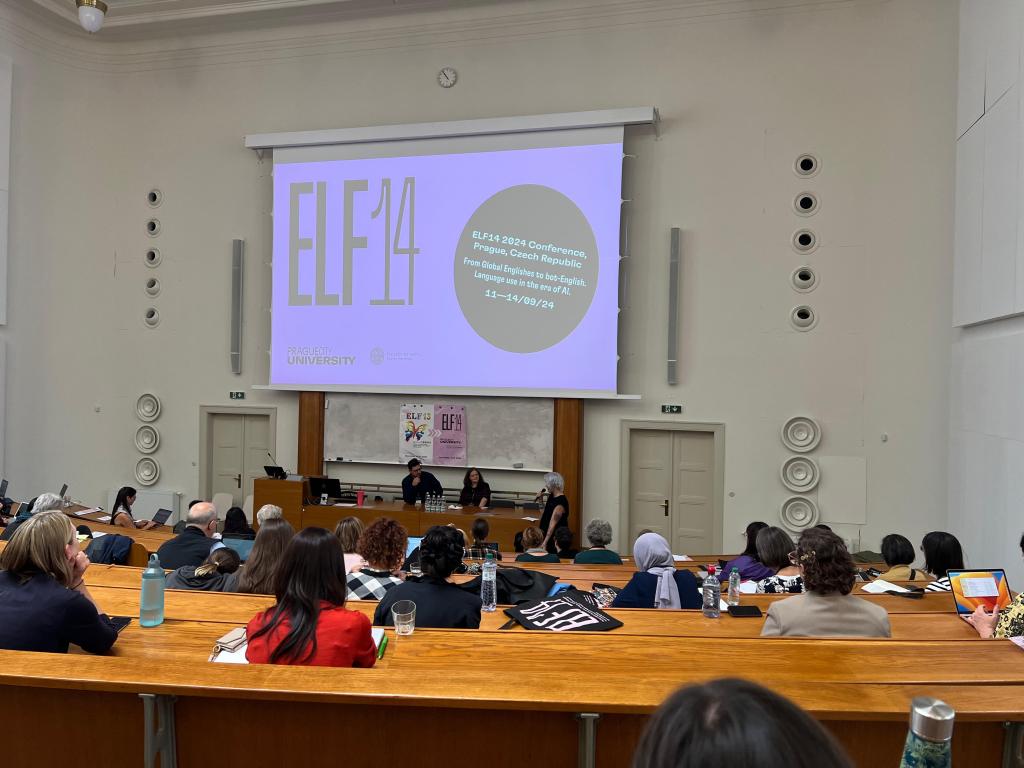
Fireside Chat: AI and ELF in LT
Day 3 (September 13): Held at both Prague City University and Charles University, the first plenary featured the CME Team with Dr. Alessia Cogo discussing “Finding ELF in Critical Language Pedagogy,” emphasizing the importance of critical consciousness and intercultural perspectives. Dr. Eowyn Crisfield’s plenary “Polarity Thinking, Liminal Spaces, and ELF” followed, addressing binarisms in ELT and advocating for a learner-centered approach. Dr. Nicos Sifakis then spoke on the integration of ELF into mainstream ELT, promoting ELF-aware interventions to enrich traditional practices. The day continued with various colloquia and presentations on topics like ELF and ELT, translanguaging, and sociolinguistics.
Day 4 (September 14): The final day began with a plenary by Dr. Yasemin Bayyurt on the intersection of ELF and disciplinary literacies in higher education. This was followed by sessions from Dr. Wenli Tsou on ESP professional development and Dr. Kurt Kohn on ELF communication from a psycholinguistic perspective. The conference concluded with a Fireside chat titled “Matters Arising,” chaired by Dr. Henry Widdowson, featuring prominent ELF researchers discussing the past, present, and future of ELF.
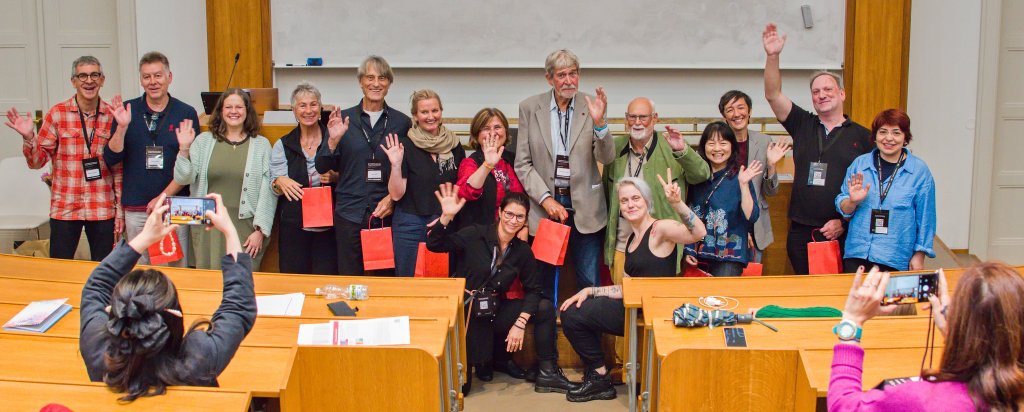
Closing ceremony by ELF scholars from all walks of life
Event organizers Veronika Quinn Novotna and Jiřina Dunková wrapped up with closing remarks, highlighting the participation of over 100 universities, 160 speakers, and representation from 5 continents, along with more than 10 teacher workshops. They also suggested holding the next ELF15 conference in a Global South country in 2026.
Language education in diverse communities: Ethics, multilingualism and teacher professionalism
Post-event Report
By: Lays Fenilli (UEM/Goldsmiths)
“Diversity is not just everywhere, it is increasing”. This was one of the topics that Professor Constant Leung emphasized in his talk organised by the CME last Tuesday (26th June 2024) at King’s College London.
To start his presentation, Professor Leung showed some statistical data showing that ethnolinguistic diversity is ever-present in many communities across the world, and used as an example the UK context in which 39.9% of the people of London are of Asian, Black and Mixed backgrounds (UK Census, 2021); 22% of school students are users/learners of English as an additional language (EAL) in England (1.6 million) (DfE, 2022). Considering this background, he argued that educational response to diversity is a key challenge of our time.
Parting from this linguistically diverse overview, he then discussed language policies, pointing that there is no place for EAL in UK’s curriculum, which is, in its turn, composed by a selection that is always ideologically driven. Still referring to language policies, Professor Leung commented on the Common European Framework of Reference (CEFR), which in its latest version (2020) has amplified the notion of plurilingualism, plurilingual competence and repertoire as well as established a connection between these ideas and the concepts of mediation and emotional intelligence as part of linguistic proficiency. Having these changes and challenges in mind, Professor Leung then questioned the role of English teachers in diverse and multilingual settings, considering the increase in sponsored professionalism that affects teachers’ autonomy, and emphasized the ethical sensibility that is required by language education if oriented by the premise of Equality of Treatment, which embraces difference as a key aspect of individuals’ unique identity.
At the end of the talk, Professor Leung brought up some thought-provoking questions such as, “If plurilingualism is part of English-medium communication, how and how far should lingua franca/translanguaging pedagogy and assessment be explicitly adopted?” The event was concluded by audience questions and discussion.
Supporting students to use generative AI tools ethically and effectively in academic writing
Post-event Report
By: Lays Fenilli (UEM/Goldsmiths)
Generative AI tools for academic writing: a friend or foe? A blessing or a curse? These were some of the questions raised at the latest CME talk, which took place last Thursday (16th May 2024) at King’s College London.
In her talk, Professor Ursula Wingate presented some results from her current project named “Supporting students to use generative AI tools ethically and effectively in academic writing”. She first presented some concerns that researchers have regarding AI use in academic writing, for example, breaches of academic integrity and plagiarism. After that, she also presented some affordances that are being pointed out as research evolves on the topic, such as helping L2 students overcome language-related inequities, promoting the use of their full linguistic repertoire and allowing more time for creativity.
After this introduction, Professor Wingate presented some examples of University guidelines for the use of AI and brought the attention to the fact that these guidelines do not foreground a critical and AI-literate use of software like generative AI (e.g. ChatGPT) or machine translation (e.g. Google Translator) neither for students nor staff. Instead of “embracing and adapting” to the use of these technologies, the guidelines impose several limitations of their use for writing assessment tasks or essays.
Enthusiastic participants during the talk
With the help of her research collaborator Rebecca Slinn, Professor Wingate then presented the workshop material developed for an intervention, which involved 23 participants from 4 BA and MA programmes. The findings showed some positive and negative reactions. There were some negative perceptions from students, stressing concerns about autonomy and insecurity regarding university policies. However, the project also highlighted the positive impact that AI can have on students’ academic writing as well as the importance of guidance, critical agency and the need for co-construction of Universities’ AI-related policies.
Help make Higher Education Institutions multilingual spaces.
Your voice matters. By supporting this petition, you voice your concern regarding multilingual spaces addressed to the Education Department of the Council of Europe, the Higher Education Unit of the European Commission, the European University Association and to Higher Education Institutions across Europe.






 multilingualismwithenglish.org